

What a Rating does and does not tell you
A Sylvera Rating tells you Sylvera’s independent assessment of the quality of a project’s carbon credits at the time of assessment. It reflects the strength of the evidence for the claims made — that the removals are or will be real, additional, and durable.- Ratings reflect conditions at the time of assessment. Carbon project risks — particularly permanence risks such as fire and drought — can change materially over time. Check whether a rating has been updated before relying on it for a new procurement decision.
- Sylvera’s Ratings do not deal with the risk of market value loss due to changes in regulation, liquidity and/or other market considerations.
- Please note: whilst our Ratings may make reference to the entities involved in the project and their track record(s), our processes do not include performing know-your-customer checks on the proponent(s). We strongly advise any buyer to always conduct enhanced KYC checks on all transaction counterparties prior to purchasing carbon credits.
Rating Structure
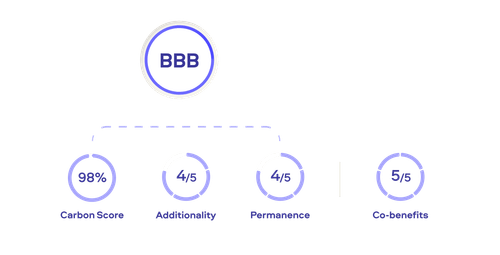
- Final letter rating — the overall quality grade from AAA (highest) to D (lowest), derived by combining the three core pillar scores through two sequential matrices
- Pillar scores
- Carbon Accounting score (1–10) — confidence in the accuracy and conservatism of the project’s claimed carbon removals
- Additionality score (1–5) — strength of evidence that the carbon removals depend on carbon finance
- Permanence score (1–5) — assessment of risks that stored carbon could be released back into the atmosphere
- Safeguarding & Co-benefits score (1–5) — supplementary signal on community and biodiversity co-benefits
Final letter rating
Sylvera expresses the quality of the project as a single letter grade on an eight-level scale, from AAA (exceptional) to D (lowest quality). The scale is designed to be immediately legible: a higher rating means greater confidence that the carbon removals claimed are real, additional, and durable.| Rating | Quality tier | What it means |
|---|---|---|
| AAA | Exceptional | Exceptional quality across all pillars. Very high confidence in claimed carbon removals, a strong additionality case, and very low permanence risk. |
| AA | High | High quality. Strong performance across all three core pillars with only minor areas of concern. |
| A | Good | Good quality. Solid performance with some moderate risk factors that limit a top-tier rating. |
| BBB | Investment grade | Meets the Sylvera recommended minimum thresholds for Carbon and Additionality Pillars. Moderate quality overall. |
| BB | Below investment grade | Meaningful concerns in one or more pillars. Buyers should exercise caution. |
| B | Significant concerns | Multiple material weaknesses across pillars. |
| C | Poor | Serious deficiencies in carbon integrity, additionality, or permanence. |
| D | Lowest | A score of 1 on any core pillar, or fundamental project failures. |
Interpreting quality
- AAA / AA / A
- BBB
- BB / B
- C/D
AAA/AA/A — High Confidence
Projects rated A or above have demonstrated strong performance across all three core pillars. At AAA, Sylvera has very high confidence that the credits represent genuine, additional, and durable carbon removal. AA projects perform strongly but may have minor residual concerns in one area. A projects are good quality but carry moderate risk factors — for example, slightly elevated permanence risk or a credible but not fully compelling additionality case — that prevent a top-tier rating.Pillar Scores
Carbon Accounting
Is the project accurately and conservatively reporting its carbon removals?
Covers carbon conservatism, over-crediting risk, reporting quality, and monitoring.
Covers carbon conservatism, over-crediting risk, reporting quality, and monitoring.
Additionality
Would the removals and/or reductions have occurred without project implementation?
Covers financial additionality, common practice, policy and regulatory context, and scenario analysis.
Covers financial additionality, common practice, policy and regulatory context, and scenario analysis.
Permanence
What is the risk of stored carbon being released back into the atmosphere?
Covers fire, drought, pest and disease, flood, storm, anthropogenic threats, project design, team quality, and country risk.
Covers fire, drought, pest and disease, flood, storm, anthropogenic threats, project design, team quality, and country risk.
Safeguarding & Co-benefits
Does the project deliver net benefits to local communities and ecosystems?
Covers community impacts and biodiversity outcomes. Reported as a supplementary 1–5 score.
Covers community impacts and biodiversity outcomes. Reported as a supplementary 1–5 score.
Carbon Accounting
Our Carbon Accounting score verifies whether a project is accurately reporting on its activities, and whether that reporting translates to its overall avoidance or removal of CO2 and other greenhouse gases (GHGs), measured in CO2 equivalent (CO2e). It runs from 1 to 10 and while the structure across frameworks may differ, all frameworks approach scoring in two ways: Project reporting, which independently benchmarks the values a project has reported, and Carbon modeling risks, which evaluates the modeling choices the project has made.There are Ratings that are scored with older frameworks where the Carbon score is out of 100% instead of a range over 10.
This is equivalent to the Project reporting score in our newer frameworks and carbon modeling risks was previously assessed as Over-crediting Risk within the Additionality score.
This is equivalent to the Project reporting score in our newer frameworks and carbon modeling risks was previously assessed as Over-crediting Risk within the Additionality score.
- Project Reporting
- Carbon Modelling Risks
Project reporting verifies whether a project is accurately reporting on its activities, and whether that reporting translates to its overall avoidance or removal of CO2 and other greenhouse gases (GHGs), measured in CO2 equivalent (CO2e). These activities include protecting forests from deforestation and planting trees. We verify them by comparing data provided by project developers against our own measurements.For REDD+, IFM, and ARR projects, we verify carbon stock changes using Sylvera’s proprietary biomass time series data. This is built from geospatial and machine learning analysis of multispectral, RADAR, and spaceborne LIDAR earth observation data, and quantifies changes in above-ground woody biomass over time (see our Biomass Data section for more information).To assess Project reporting, we analyze both the project area and the leakage area, where relevant. We also provide outlook commentary describing forest area changes in the project since its last verification report.
| Score | What it means |
|---|---|
| 10 | Indicates very high confidence that the project’s reported carbon impact is accurate, with no material over-crediting risk identified. |
| 9 | Indicates high confidence that the project’s reported carbon impact is accurate, with only minor uncertainties. |
| 8 | Indicates strong confidence that the project’s reported carbon impact is accurate. |
| 7 | Indicates the project’s reported carbon impact is likely accurate, with some uncertainty in the modeling or reporting approach. |
| 6 | Indicates moderate confidence in the project’s reported carbon impact, with a few unresolved uncertainties. |
| 5 | Indicates uncertainty about the project’s reported carbon impact, but no major red flags identified. |
| 4 | Indicates notable uncertainty about the project’s reported carbon impact, with one or more identified risk factors for over-crediting. |
| 3 | Indicates the project’s reported carbon impact is likely overstated, with multiple identified risk factors for over-crediting. |
| 2 | Indicates significant discrepancies between the project’s reported carbon impact and Sylvera’s own analysis, suggesting high over-crediting risk. |
| 1 | Indicates we found a serious red flag questioning the accuracy of the project’s carbon quantification claims. |
Additionality
Additionality refers to the causal relationship between a project’s activities and the climate benefits it claims. A project is considered additional if its activities would not have occurred without revenue from voluntary carbon credits. The Additionality score is made up of three subcomponents, together known as Additionality of Activities: Financial additionality, Policy and regulation, and Common practice. This structure applies across all Rating Frameworks and project types, though the data, focus, and analysis techniques used vary by project type- Financial additionality
- Policy and regulation
- Common practice
How far carbon credit revenue has driven the investment decision behind a project’s activities, assessed through direct financial analysis or proxies such as by-products or known financial barriers to implementation.
| Score | What it means |
|---|---|
| 5 | Indicates very high confidence that a project is additional. |
| 4 | Indicates high confidence that the project is additional. |
| 3 | Indicates the project is likely additional. |
| 2 | Indicates uncertainty about the project’s impact claim but overall still believe it may be additional |
| 1 | Indicates we found a serious red flag questioning the project’s claims of additionality. |
Permanence
Permanence scores represent the degree of confidence that carbon avoidance or removal will persist for an atmospherically relevant timeline. To assess this, we evaluate the likelihood and severity of natural and human causes of forest loss, to determine the project’s risk of carbon stock loss. Renewables and landfill methane projects don’t store CO2 that could later be released. Because there’s no reversal risk, permanence isn’t considered a material risk factor for these project types, and they receive high Permanence scores (5 out of 5).| Score | What it means |
|---|---|
| 5 | Indicates a very high permanence, the project carbon credits are very likely to be valid beyond the claimed period. |
| 4 | Indicates high permanence, the project carbon credits are likely to be valid for the claimed period. |
| 3 | Indicates low permanence, the project carbon credits are unlikely to be valid for the claimed period. |
| 2 | Indicates low permanence, the project carbon credits are unlikely to be valid for the claimed period. |
| 1 | Indicates a very low permanence, the project carbon credits are highly unlikely to be valid for the claimed period. |
Safeguarding & Co-benefits
The Safeguarding & Co-benefits score is not used to calculate the final rating. It is reported as a supplementary quality signal to help you evaluate community and environmental dimensions alongside the core carbon integrity metrics.
| Score | What it means |
|---|---|
| 5 | Indicates exceptional progression of targeted SDGs, as well as extraordinary species richness and high quality activities to reduce pressure on biodiversity. |
| 4 | Indicates strong progression of targeted SDGs, as well as high species richness and quality activities to reduce pressure on biodiversity. |
| 3 | Indicates average progression of targeted SDGs, as well as average species richness and adequate activities to reduce pressure on biodiversity. |
| 2 | Indicates narrow progression of targeted SDGs, or low species richness and limited activities to reduce pressure on biodiversity. |
| 1 | Indicates very limited progression of targeted SDGs, as well as very low species richness and deficient activities to reduce pressure on biodiversity. |
Handling Missing Data
Sylvera’s newest frameworks assess projects as robustly as possible, independent of a project’s data disclosure status. This includes pre-issuance projects: we’ve adapted our frameworks to score these projects using the same rigorous approach applied post-issuance. When data typically needed to fully evaluate a project is missing or incorrect, we rate the project through alternative pathways. The Rating either uses independently generated information as a proxy to estimate the project’s quality, or assigns probable scores inferred from the score distribution of a comparable sample of analyzed projects. We assign a confidence level to each affected pillar, representing the uncertainty caused by missing data. This confidence level assumes that the risk associated with missing information can be quantified using percentile estimates derived from a representative sample. Regardless of how much project data is available, the Rating uses the same scoring approach. Our frameworks assess carbon credits based on the best information available, taking into account the risk and probable impact of any missing information. When new data becomes available and meets our criteria for rigorous analysis, we reassess the project and update both the pillar score and the confidence level.Provisional Ratings
Some legacy Ratings were scored using older frameworks, which handled missing data differently than our current approach. These are Provisional Ratings: they represent our best estimate of a project’s quality, accounting for existing uncertainties, and are provided on the same eight-level AAA–D scale as other Full Ratings. The analysis clearly states which pillar has missing information. For the Carbon pillar specifically, a numeric score isn’t given. Instead, one of the following labels may be assigned:| Score | What it means |
|---|---|
| Provisionally negative Carbon score | Indicates that the project’s claimed emissions reductions and/or removals are likely overstated. This label is only possible to calculate in some pre-verification instances, and not for other provisional Full Rating cases. |
| Provisionally neutral Carbon score | Indicates that the project’s claimed emissions reductions and/or removals cannot be verified, or that there are mixed indicators as to whether the claims are correct. |
| Provisionally positive Carbon score | Indicates that the project’s claimed emissions reductions and/or removals are likely correct. This label is only possible to calculate in some pre-verification instances, and not for other provisional Full Rating cases. |